Nine new species of the genus Micropsalliota (Agaricaceae) have been found in Vietnam
20/07/2026Micropsalliota is a genus of small fungi belonging to the family Agaricaceae. Currently, about 60 species have been described in this genus, mostly distributed in tropical regions.
Representatives of Micropsalliota are characterized by morphological features: small and slender to medium sized basidiomata, smooth or scaly pileal surface, free or emarginate lamellae, dark brown or violet spore prints, membranous partial veil, often ellipsoid, oval and amygdaliform basidiospores with apical endosporal thickening, cheilocystidia of different shapes and sizes, sometimes with pleurocystidia and pileocystidia, pileipellis composed of hyphae incrusted with a pigment, rarely with an epithelium. The Micropsalliota species are saprotrophic, can be encountered solitary or gregarious, on soil or on destroyed termite mounds.
The research group of the E-1.5 project “Tropical forest fungi of Vietnam: diversity in classification, ecology, structure, and function” of the Joint Vietnam–Russia Tropical Science and Technology Research Center has recorded nine species new to science belonging to the genus Micropsalliota in national parks, nature reserves and natural ecosystems of Vietnam: Kon Ka Kinh National Park in 2016 (Gia Lai), Ba Vi National Park in 2011 (Hanoi), Bu Gia Map National Park in 2016 (Dong Nai), Ta Dung National Park in 2022 (Lam Dong), Kon Chu Rang Nature Reserve in 2016 (Gia Lai), and Dam Bay in 2021 (Khanh Hoa).
1. M. alexandrovae D.D. Ivanova & O.V. Morozova, sp. nov.
Basidiomata medium-sized, growing in clusters, white or beige when fresh, brown when dry, yellowish-brown when bruised or cut. Pileus (15–)16–20 (–22) mm in diameter, convex, obtusely-conical, with an umbo, white; surface rough with small raised white scales. Lamellae free, frequent, 1–2 mm wide, with 1–2 series of lamellulae, white or cream-colored, turning brown with age. Stipe (55–)70–70–(–110) × 1–2 mm, cylindrical, white or gray-brown; surface covered with small white scales. Annulus white, attached, membranous, single. Odour anise-like (Figure 1).
2. M. candida D.D. Ivanova, O.V. Morozova & T.H.G. Pham, sp. nov.
Basidiomata small, growing in groups, white when fresh, fading to light brown with drying. Pileus 4–8 mm in diameter, convex, becoming flattened-convex with age; surface covered with small white flocculent scales; margins appendiculate, with a white flocculent border. Lamellae free, 0.6–0.8 mm wide, swollen, with 1–2 series of lamellulae, cream-colored, turning brown with age, edges paler. Stipe 5–10 × 0.5–0.7 mm, cylindrical, concolorous with pileus, covered with small fine fibrils. Annulus membranous, single, covered with small fine hairs (Figure 2).
3. M. casta D.D. Ivanova, O.V. Morozova & T.H.G. Pham, sp. nov.
Basidiomata small, growing solitary, turn red-orange when bruised or cut. Pileus 10–12 mm in diameter, flat, with a small obtuse umbo in the center, white, covered with small brown fibrous scales that gradually turn white toward the margin. Lamellae free, frequent, 0.7–1 mm wide, slightly ventricose, interspersed by lamellulae. Stipe 10–12 × 1–1.3 mm, cylindrical, wider toward the base, gray, covered with frequent, fine white fibrils. Annulus grayish-pinkish, deciduous, membranous, with faint striation (Figure 3).
4. M. cygnea D.D. Ivanova, O.V. Morozova & T.H.G. Pham, sp. nov.
Basidiomata tiny, growing in small groups, snow-white when fresh, when drying the surface of pilei fades to a gray-pink color, and the stipe to brown. Pileus (3–)4–5(–8) mm in diameter, initially campanulate-convex, becoming plane with a central depression with age; surface smooth, striate at the margin with age, entirely white. Lamellae emarginate, 0.5–0.8 mm wide, with 1–2 series of lamellulae, white. Stipe 9–13 × 0.7–0.9 mm, cylindrical, white, covered with small white scales. Annulus not observed (Figure 4).
5. M. dudkae D.D. Ivanova, Ageev & T.H.G. Pham, sp. nov.
Basidiomata small, solitary, light-rose. Pileus 5–9 mm in diameter, initially campanulate, later convex, veil remnants overhanging the margin, white, the surface covered with dirty-pink small, appressed, hairy scales, which become denser toward the center, forming a piliculeus that cracks as the basidioma develops. Lamellae free, frequent, 0.8–1 mm wide, with 1–2 series of lamellulae, white. Stipe 13–15 × 1 mm, cylindrical, the surface covered with small, fibrillose, white scales. Annulus not observed (Figure 5).
6. M. patouillardii D.D. Ivanova & V.A. Dudka, sp. nov.
Basidiomata small, growing in groups, dirty-white. Pileus 5–10 mm in diameter, initially hemispherical and obtusely conical, then convex and flattened; the surface is dry, white, covered with tiny, sparse fibrous scales of a brown-wine color. Lamellae free, ventricose, subdistant, grayish-pinkish, with lamellulae. Stipe 5–13 × 0.3–0.5 mm, cylindrical, thin, white, yellowish with age, covered with tiny scales, same as on the pileus. Annulus not observed (Figure 6).
7. M. poilanei D.D. Ivanova & O.V. Morozova, sp. nov.
Basidiomata medium-sized, growing in groups, white when fresh, fading to dark brown when dry. Pileus 20–30 mm in diameter, convex, flat-convex, often with an umbo, cream-colored; the entire surface is covered with small, flattened, fibrillose, brown and light-brown scales. Lamellae free, frequent, 2–3 mm wide, with 1–2 series of lamellulae, initially white, becoming creamy when mature. Stipe 40–60 × 1–2 mm, cylindrical, white or cream-colored, smooth or with indistinct longitudinal fibrils. Annulus white, attached, membranous, with indistinct striations (Figure 7).
8. M. pseudoglobovelveta D.D. Ivanova & O.V. Morozova, sp. nov.
Basidiomata small and white. Pileus 2–5 mm in diameter, convex. Lamellae free, subdistant, 0.4–0.6 mm wide, ventricose. Stipe 8–14 × 0.6–0.8 mm, cylindrical. Annulus white, fugacious (Figure 8).
9. M. nivea D.D. Ivanova, A.V. Alexandrova & T.H.G. Pham, sp. nov.
Basidiomata small, growing in small groups, white when fresh, turning orange when bruised or cut. Pileus 3–7 mm in diameter, initially campanulate and convex, becoming convex with umbo with age, the surface smooth, dry, slightly velvety, completely white. Lamellae free, frequent, 0.5–0.9 mm wide, with 2 series of lamellulae, cream-colored. Stipe 16–23 × 0.8–1 mm, cylindrical, concolorous with the pileus, smooth. Annulus ephemeral, membranous (Figure 9).
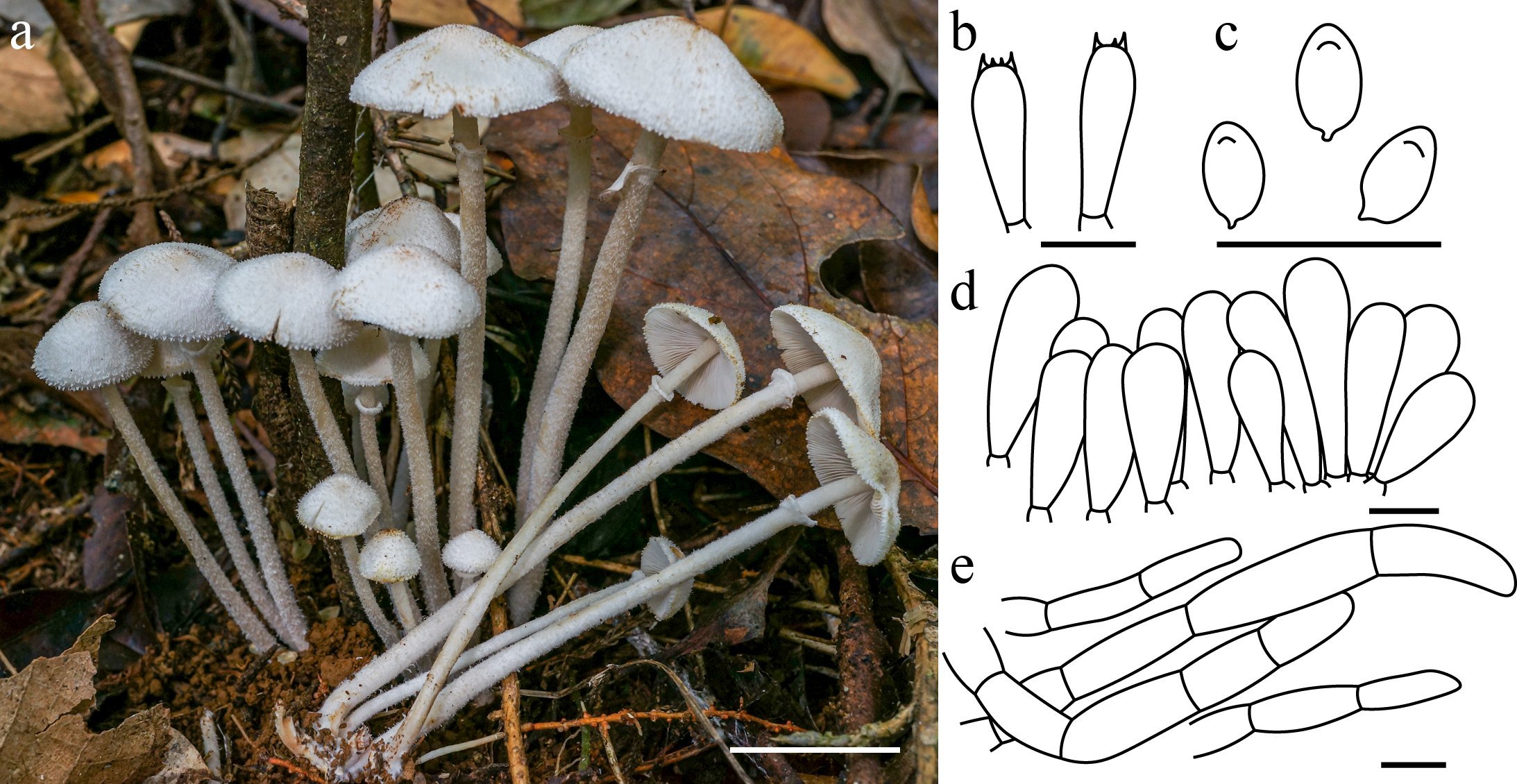 Figure 1: Micropsalliota alexandrovae : a basidiomata in situ, b basidia, c basidiospores, d cheilocystidia, e pileipellis. Bars: a = 10 mm; b–d = 10 μm; e = 20 μm.
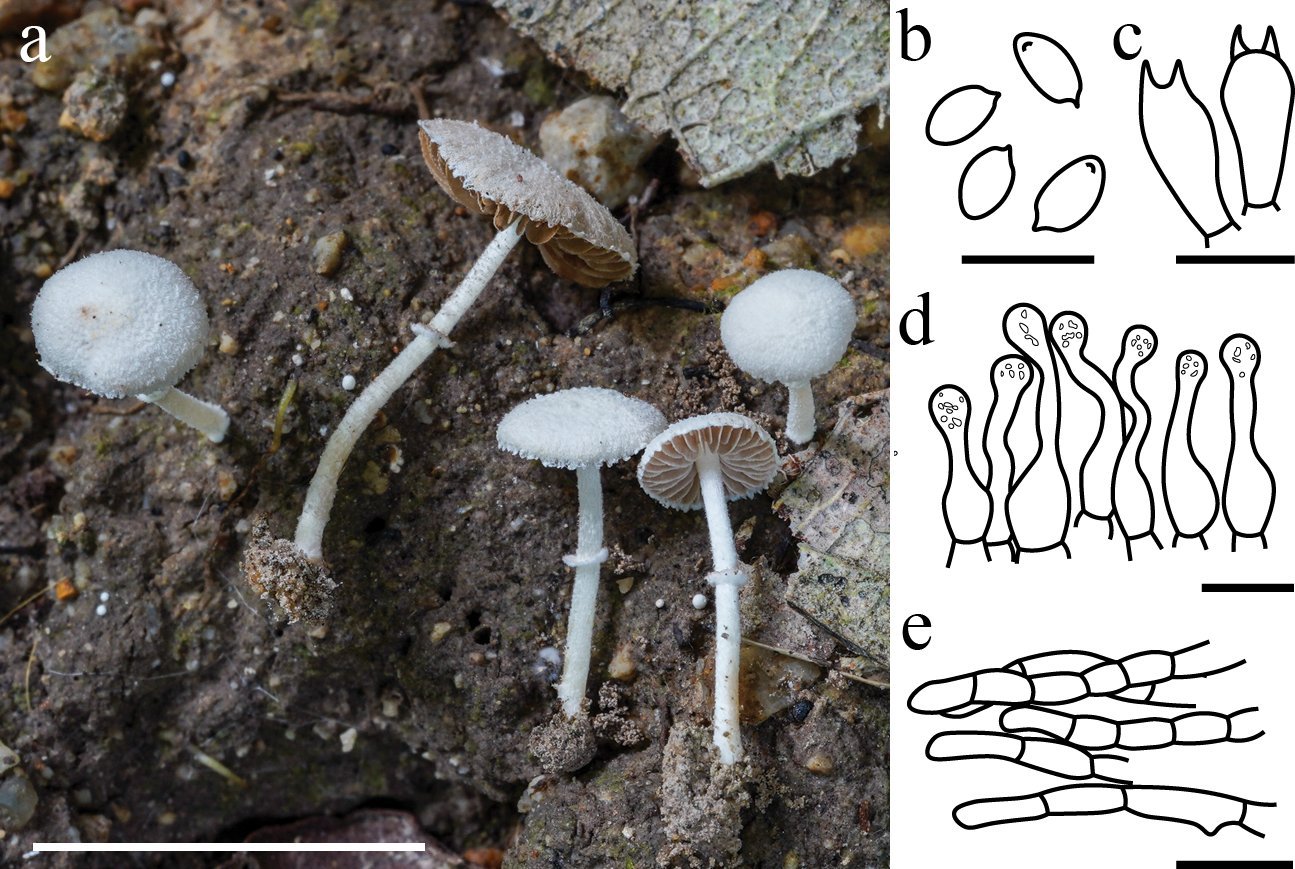 Figure 2: Micropsalliota candida: a basidiomata in situ, b basidiospores, c basidia, d cheilocystidia, e pileipellis. Bars: a = 10 mm; b–d = 10 μm; e = 20 μm.
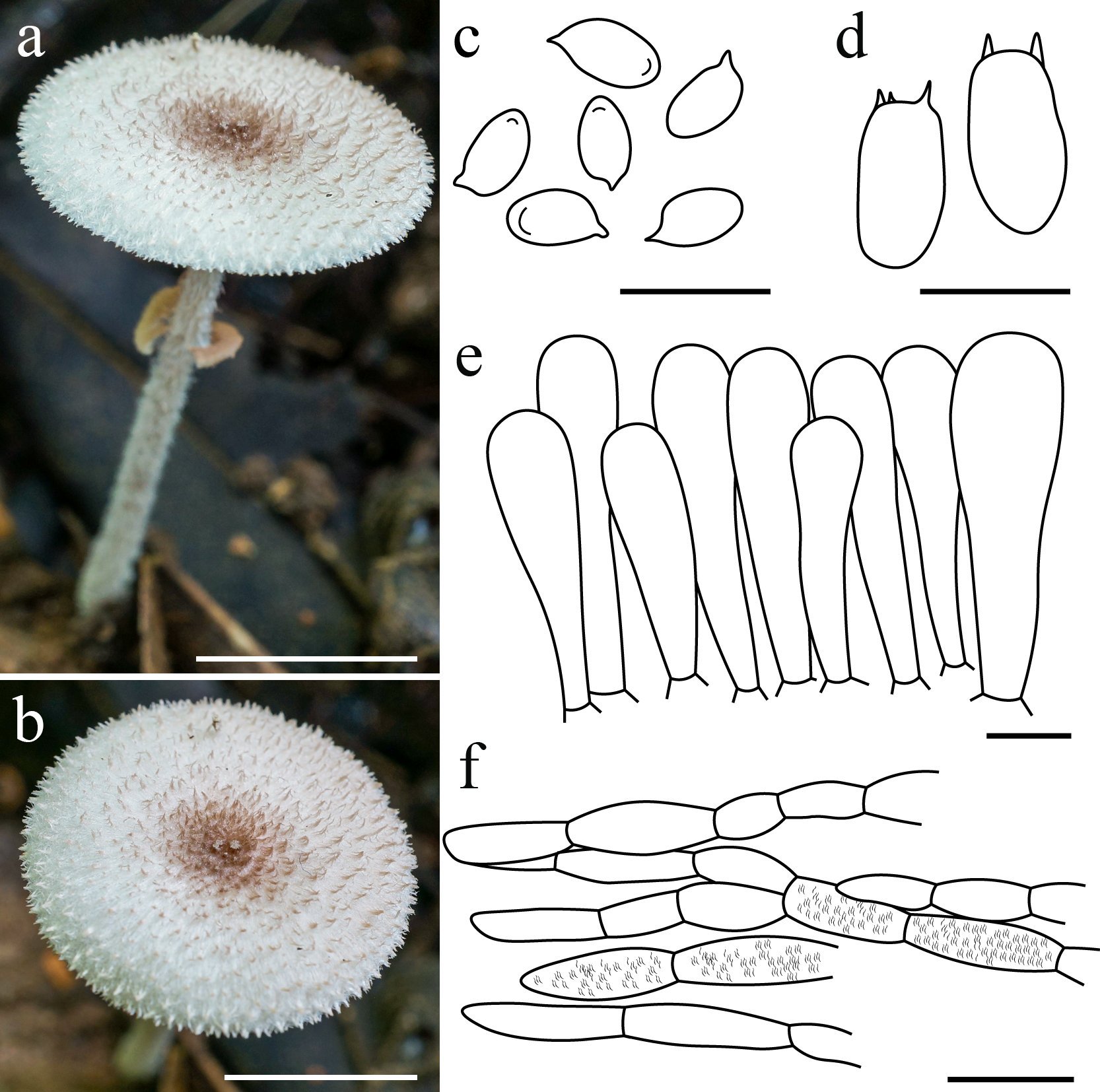 Figure 3. Micropsalliota casta: a–b basidiomata in situ, c basidiospores, d basidia, e cheilocystidia, f pileipellis. Bars: a–b = 10 mm; c–d = 10 μm; f = 50 μm.
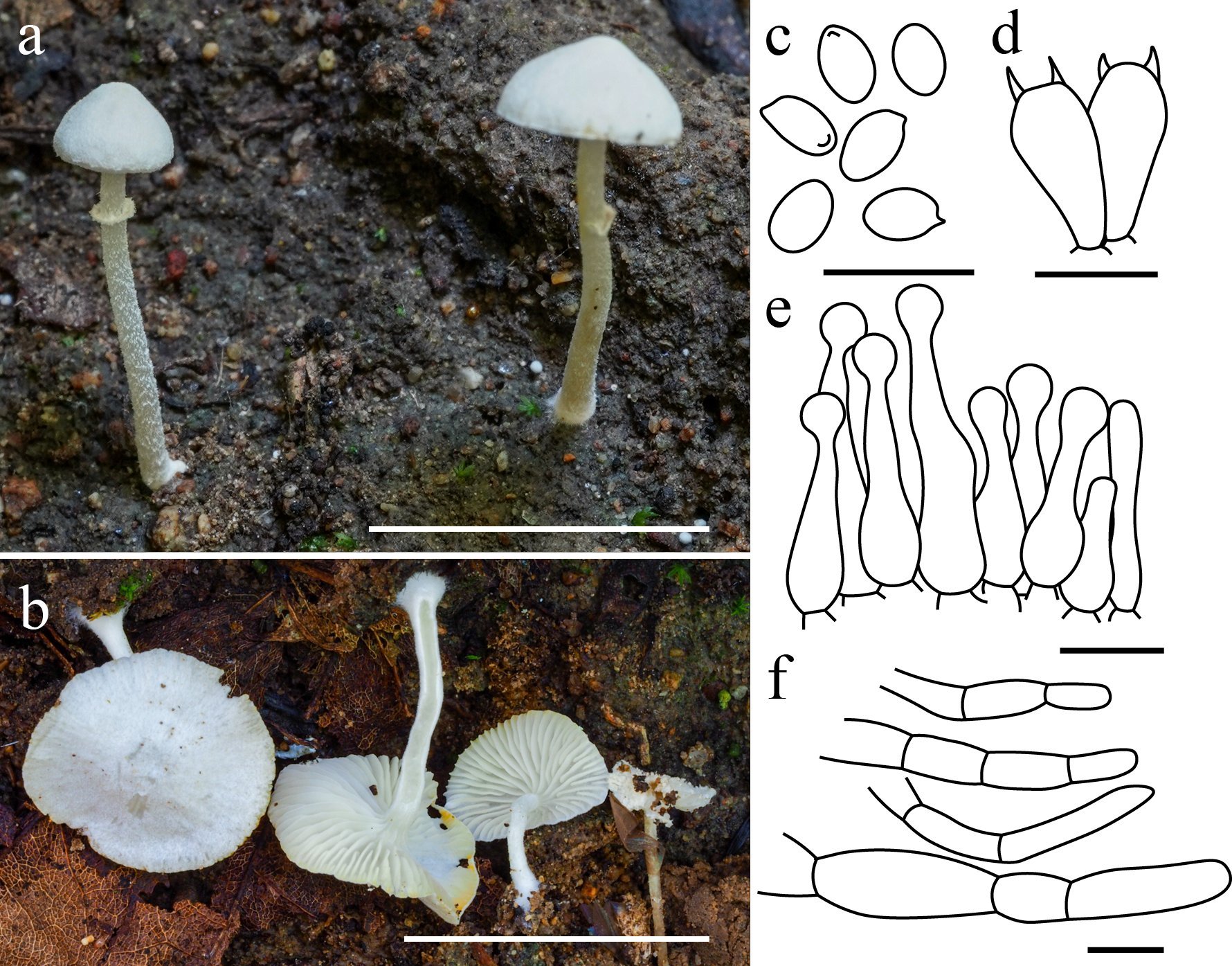 Figure 4. Micropsalliota cygnea: a basidiomata in situ, b basidiomata in situ, c basidiospores, d basidia, e cheilocystidia, f pileipellis. Bars: a–b = 10 mm; d–e = 10 μm; f = 20 μm.
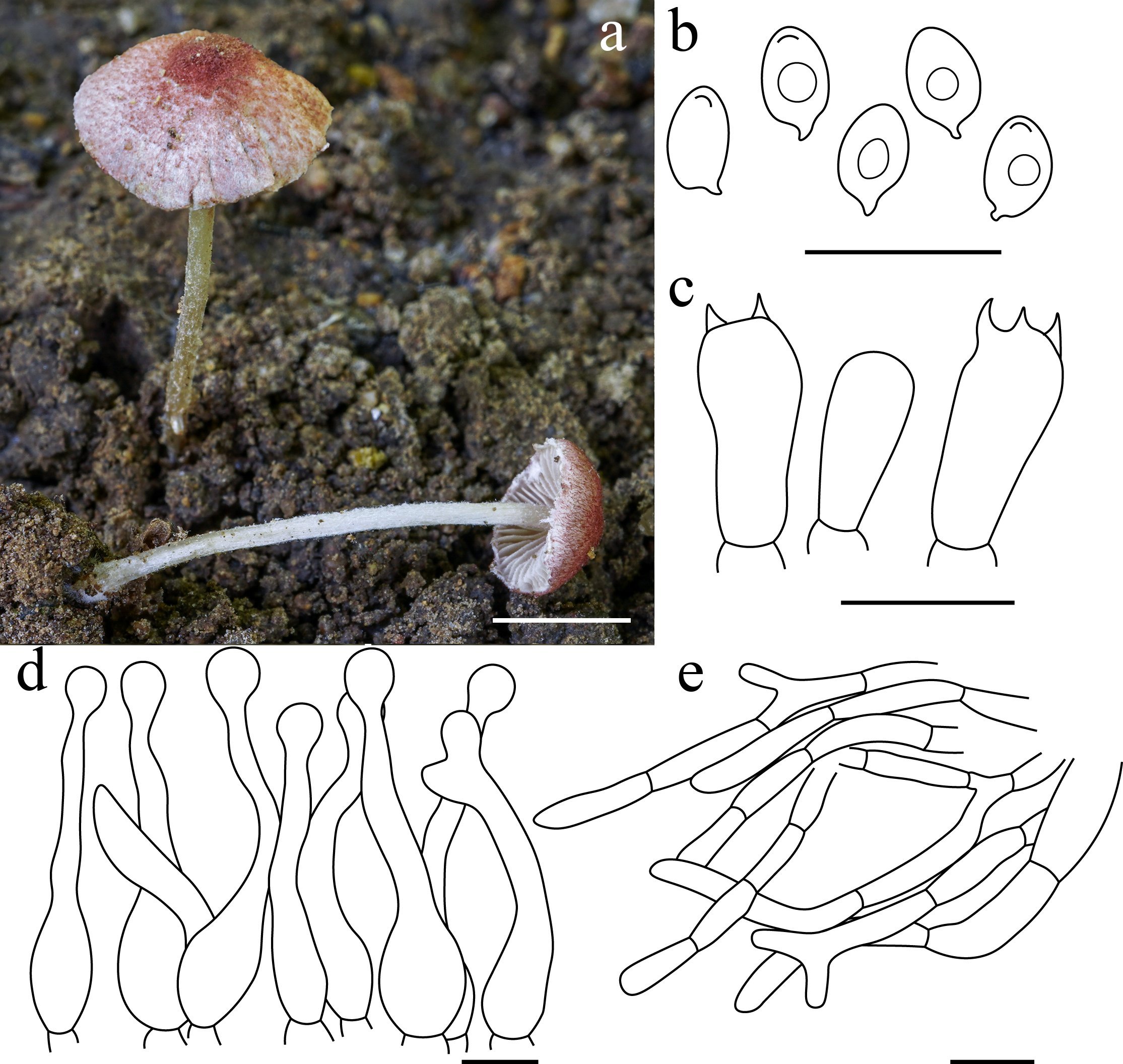 Figure 5. Micropsalliota dudkae: a basidiomata in situ, b basidiospores, c basidia, d cheilocystidia, e pileipellis. Bars: a = 5 mm; b–d = 10 μm; e = 20 μm.
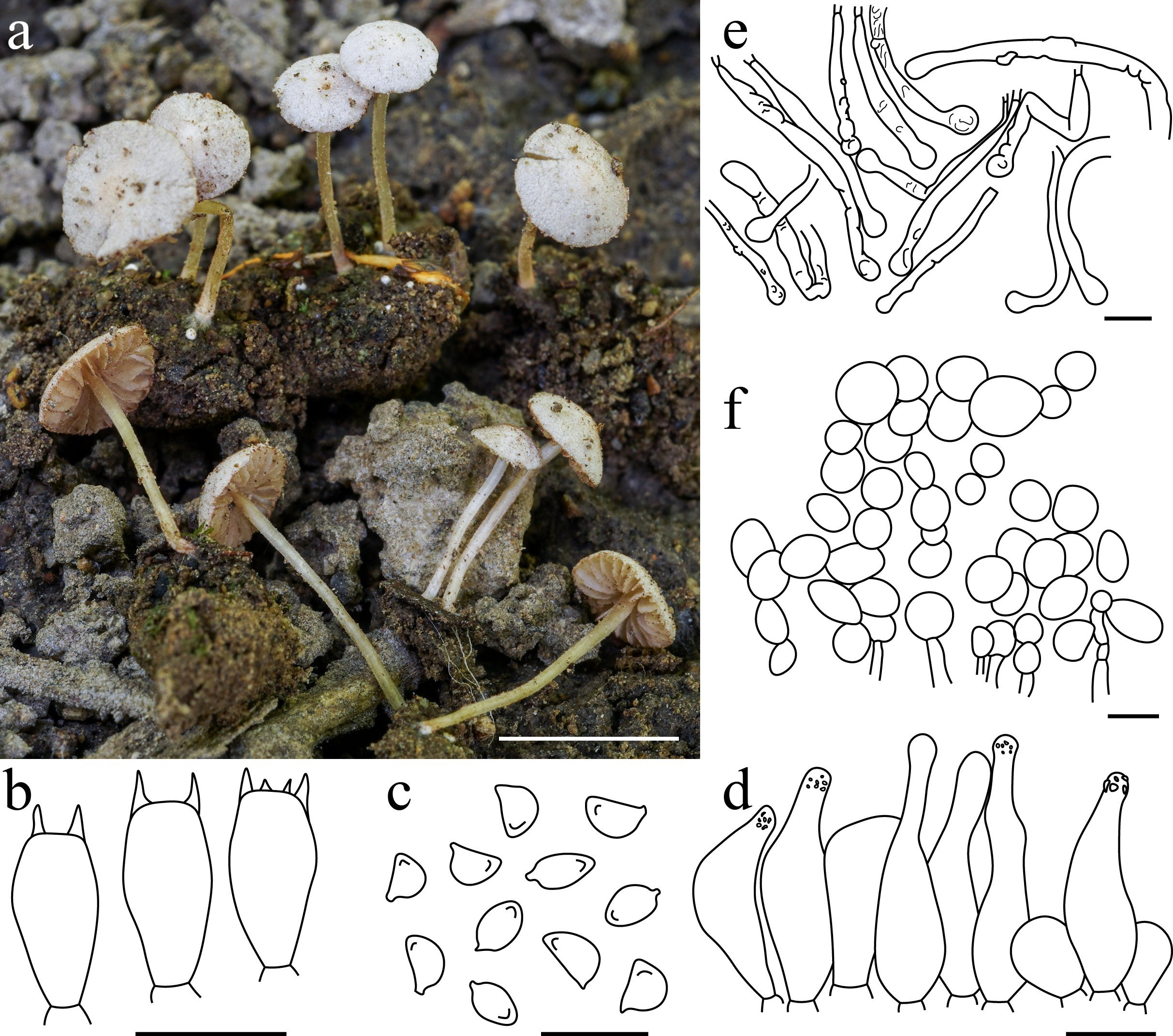
Figure 6. Micropsalliota patouillardii: a basidiomata in situ, b basidia, c basidiospores, d cheilocystidia, e pileocystidia, f pileipellis. Bars: a = 10 mm; b–d = 10 μm; f = 20 μm.
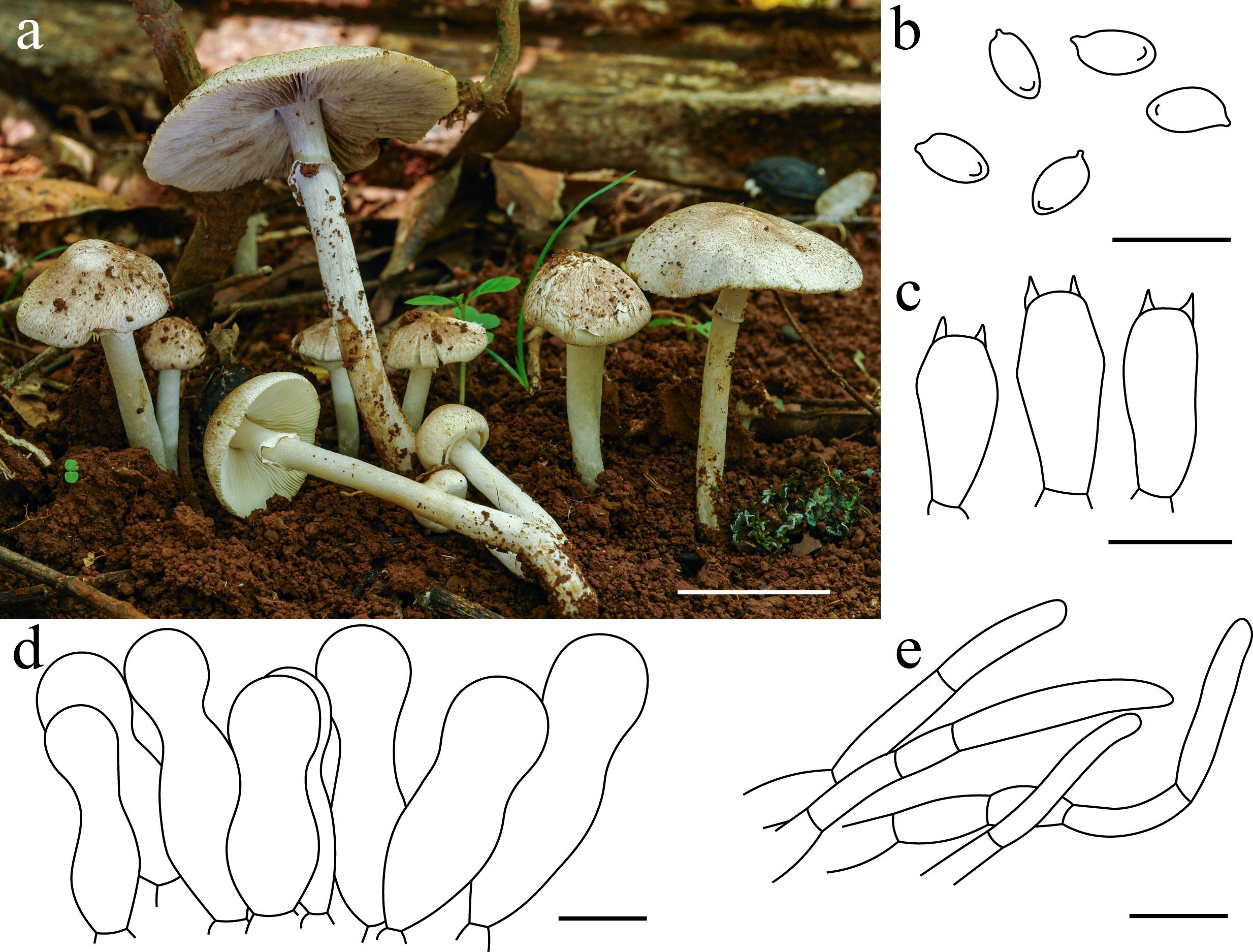 Figure 7. Micropsalliota poilanei: a basidiomata in situ, b basidiospores, c basidia, d cheilocystidia, e pileipellis. Bars: a = 10 mm; b–d = 10 μm; e = 20 μm.
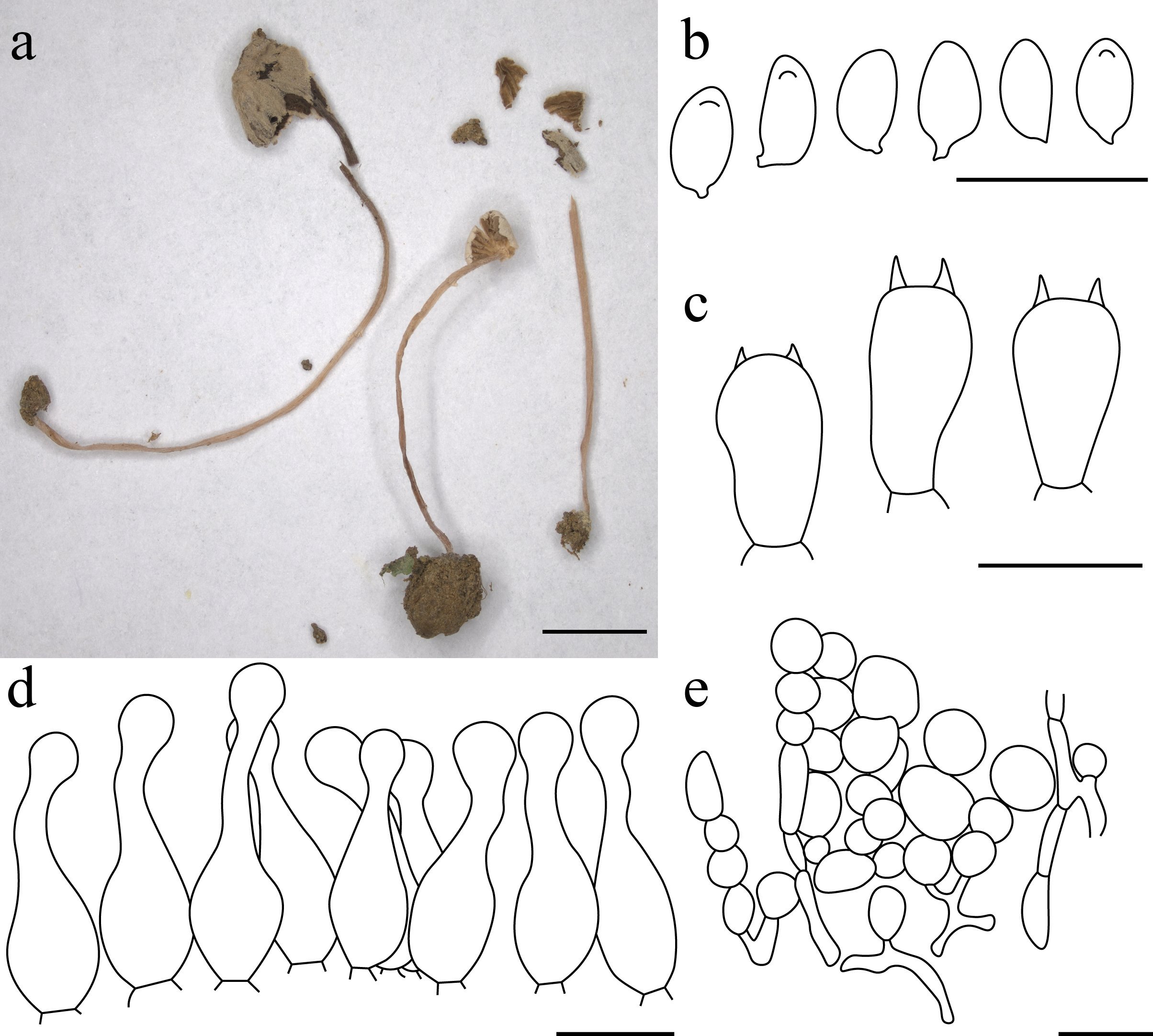
Figure 8. Micropsalliota pseudoglobovelveta: a basidiomata in situ, b basidiospores, c basidia, d cheilocystidia, e pileipellis. Bars: a = 10 mm; b–d = 10 μm; e = 20 μm.
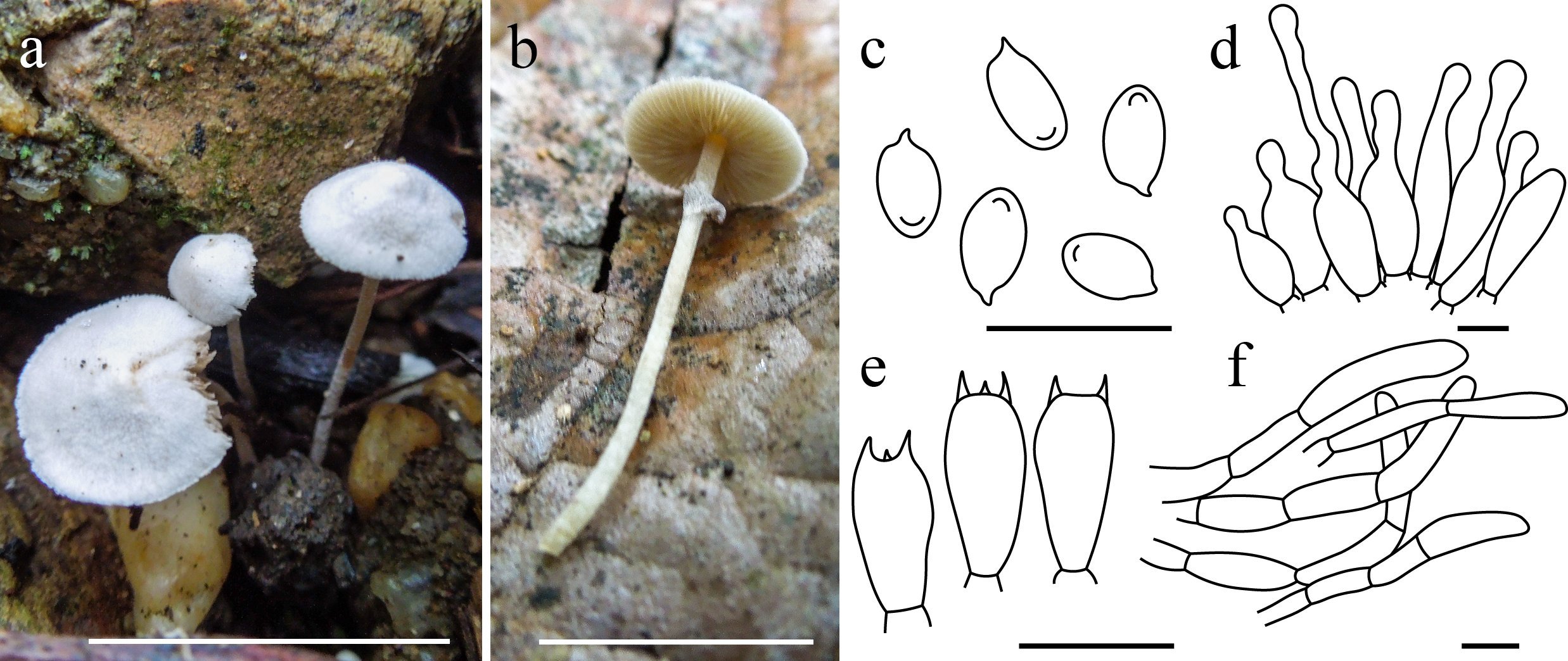 Figure 9. Micropsalliota nivea: a–b basidiomata in situ, c basidiospores, d cheilocystidia, e basidia, f pileipellis. Bars: a–b = 10 mm; c–e = 10 μm; f = 20 μm.
References: Daria Ivanova, Dmitriy V. Ageev, Olga Morozova and Thi Ha Giang Pham. Micropsalliota (Agaricaceae, Agaricomycetes) of Vietnam: results of long-term research and description of new taxa. Mycological Progress 25, 45 (2026) https://doi.org/10.1007/s11557-026-02158-8.