Two Lepiota species recorded for the first time in Vietnam
14/12/2025Lepiota is a fungal genus in the family Agaricaceae, order Agaricales. The genus currently comprises approximately 400 recognized species worldwide, several of which contain amatoxins and may be fatal to humans.
The research team of project E1.5, “Fungal biota of Vietnam’s tropical forests: taxonomic diversity, ecology and structural–functional characteristics,” under the Joint Vietnam-Russia Tropical Science and Technology Research Centre, recorded two Lepiota species in tropical evergreen in Cát Bà National Park: L. erythrosticta and L. omninoflava. Both species are reported as new for Vietnam. Lepiota erythrosticta represents the sect. Stenosporae, possesses spurred basidiospores and purple basidiomata. Lepiota omninoflava belongs to the sect. Eriophorae, has ovoid basidiospores and yellowish basidiomata.
Lepiota erythrosticta (Berk. & Broome) Sacc.
Pileus 15 mm in diameter, obtusely umbonate, the surface dark violet, dark vinaceous, darker and continuous at the disk, disrupting to purple squamules on whitish ground towards the margin, the margin is slightly appendiculate. Stipe white, striate below the annulus due to presence of purple fibrillose squamules or scattered subannular belts from the veil, hollow, with branched rhizomorphs at the base. Annulus fugacious.
Basidiospores 7.8-10.6 × 3.2-4.5 µm, Q: 2.08-3, Qm = 2.44 (n = 21), in frontal view oblong, in lateral view spurred, with protracted abaxial base and acute apex, dextrinoid. Basidia 21.5-27.8 × 8.2-9.8 µm, clavate, thin-walled, hyaline, 4-spored.
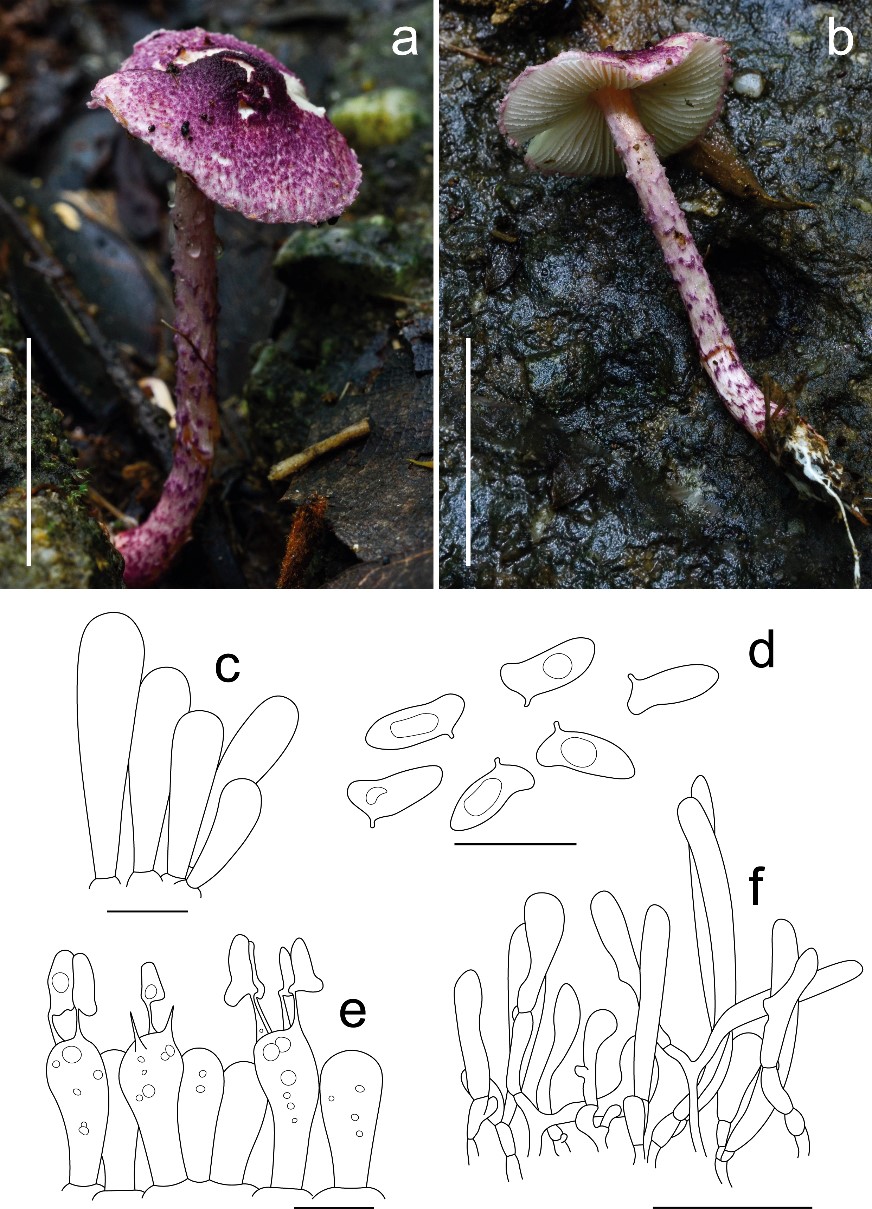
Lepiota erythrosticta: (a, b) basidiomata in situ, (c) cheilocystidia, (d) basidiospores, (e) basidia, (f) pileus covering. Bars: a, b = 1cm; c–e = 10μm; f = 50μm
Lepiota omninoflava Y.J. Hou & Z.W. Ge
Pileus 4 mm in diameter, plano-convex, , the surface covered with yellowish brown pyramidal, spiny scales that are located denser in the center; margin with more or less dictinguished flocculose velar remnants. Lamellae free, intercalated with lamellulae. Stipe subcylindrical, yellowish white, the sutface covered with tiny fibrillose scales, pale towards the pileus, yellow and denser below the annular zone. Annulus fugacious, barely visible as yellowish brown fibrous remnants.
Basidiospores 4.5-5.5 × 2.7-3.4 µm, Q: 1.47–2.04, Qm = 1.7 (n = 21) ellipsoid or subovoid, thin-walled, dextrinoid. Basidia 14-19.1 × 5.1-6.7 µm, clavate, thin-walled, hyaline, 4-spored.
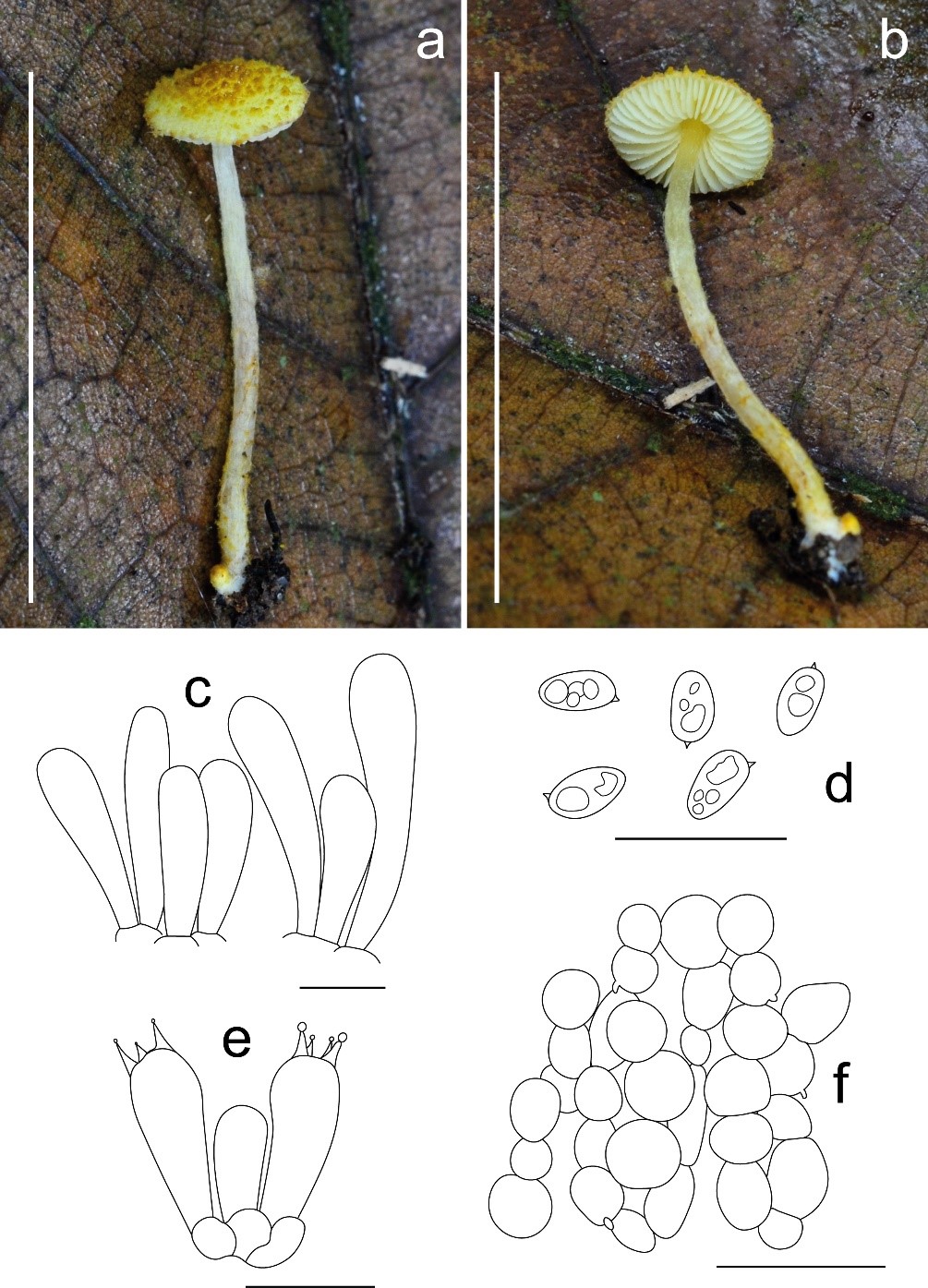
Lepiota omninoflava: (a, b) basidiomata in situ, (c) cheilocystidia, (d) basidiospores, (e) basidia, (f) pileus covering. Bars: a, b = 1cm; c–e = 10μm; f = 50 μma.
Author: PhD. Pham Thi Ha Giang (Institute of Tropical Ecology/VRTC)